A company brain is the written, shared record of what a company knows: its customers, offers, voice, decisions and repeatable processes, kept in one place that both people and their AI tools read and update. It pulls together knowledge that would otherwise sit in individual chats, laptops and people's heads, and unlike a wiki, it's written for AI tools to use at the start of each task, and it has rules about who can see what.
Key takeaways
- A company brain holds facts, decisions and processes, written once and read by every tool.
- The memory built into each AI tool belongs to one person, one project or one computer, so the team can't share it.
- It stays useful when people save new decisions to it as part of finishing the work.
To keep this concrete, picture a 12-person consultancy. Each partner has years of client history in their head, each consultant has a Claude or ChatGPT account full of good prompts, and none of it is written anywhere the rest of the firm's AI tools can find.
What does "company brain" actually mean?
A company brain is the company's working knowledge, written down where people and AI tools can both use it. The term is new and vendors define it in slightly different ways, though they all describe a lasting store of what the organization knows that AI tools can read.
The problem behind it is much older. Panopto's Workplace Knowledge and Productivity Report, a survey of 1,000 US workers, found that 42% of institutional knowledge is unique to the person in that role [1].
5.3 hrs
That's the time a US knowledge worker spends each week waiting for information or recreating it.Source: Panopto via HR Dive, 2018
The same report put the cost of inefficient knowledge sharing at $47 million a year for a large US business [1]. AI tools make that gap easier to see, since each one starts every session knowing nothing about the firm until someone tells it.
What goes in a company brain, and what stays out?
The brain should hold the knowledge that's true for the whole team and useful to more than one task. For the consultancy, that comes down to five kinds of file:
What goes in
Company facts cover what the firm sells, its rates policy and who does what.
Each client gets one file with its background, contacts and the current engagement.
Voice and standards files say how the firm writes reports, decks and emails.
Decision records note what was decided, when and why, including outcomes from client calls.
Processes turn repeatable work into written instructions, like a kickoff checklist or a weekly status report.
What stays out
Passwords and API keys belong in a secrets store, and drafts nobody has checked or one person's private preferences don't belong here either.
Every file should be plain text a person can read and fix, and every file needs an owner who keeps it current.
How is a company brain different from a wiki or AI memory?
A wiki is written for people to browse, and AI memory is kept for one person, while a company brain is written for AI tools to read and shared across the team. Built-in AI memory shows the gap clearly:
- In Claude chat, each project has its own memory that other projects can't see [2].
- Claude Code's auto memory is machine-local and isn't shared across machines [3].
- Codex reads AGENTS.md files and stops adding them at 32 KiB by default [4], which suits rules and doesn't suit a whole firm's client history.
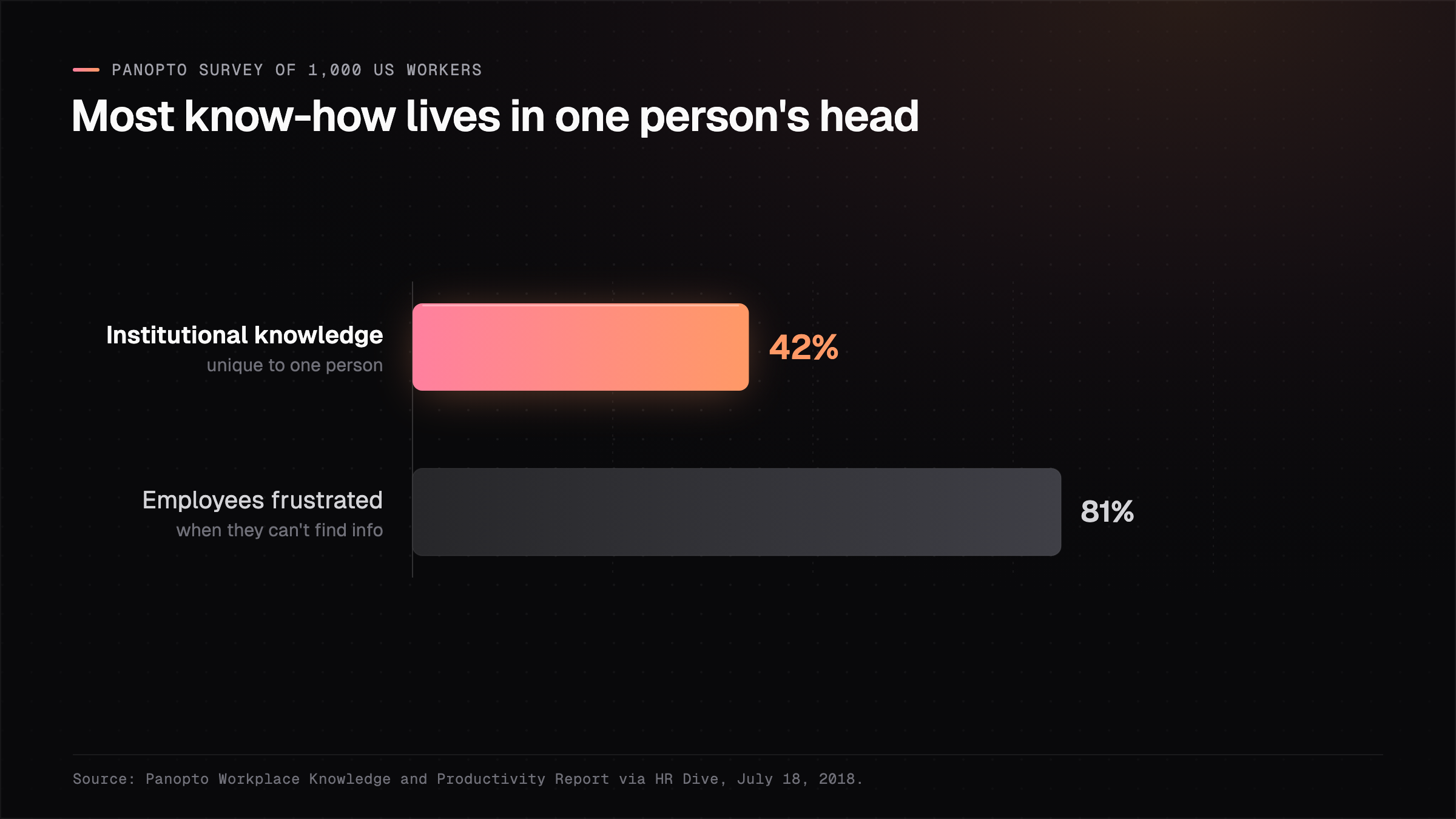
The same Panopto report found that 81% of employees feel frustrated when they can't get the information they need to do their job [1]. A company brain covers less ground than a shared workspace for your team's AI, which adds bots, access rules and policies on top of the knowledge.
A company brain is the knowledge part, and it's useful only if every tool on the team can read it.
How do you keep a company brain from going stale?
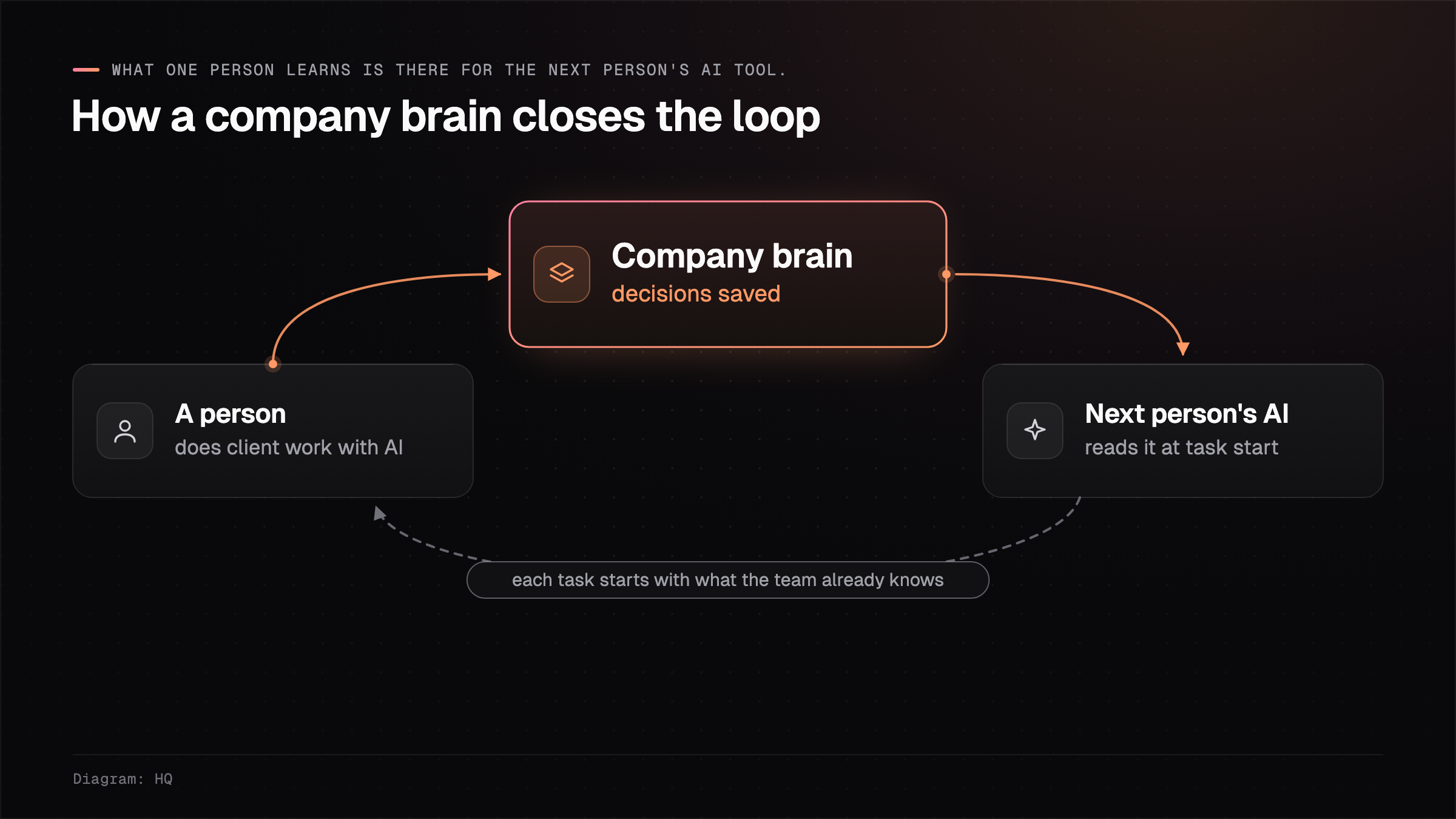
Teams keep a company brain current by making saving to it part of finishing the work, so updates happen when decisions do. If someone only tidies it once a quarter, it falls behind the decisions the team makes in between.
Quick check: ask two teammates to ask their AI tool the same question about your biggest client. If the answers differ, your firm's knowledge is still sitting in separate memories.
For the consultancy, three habits do most of the work. A consultant ends each client call by saving the decisions to that client's file, a partner who corrects an AI draft updates the voice file instead of just the draft, and anyone who runs the same task three times writes it up as a process.
How this works in HQ
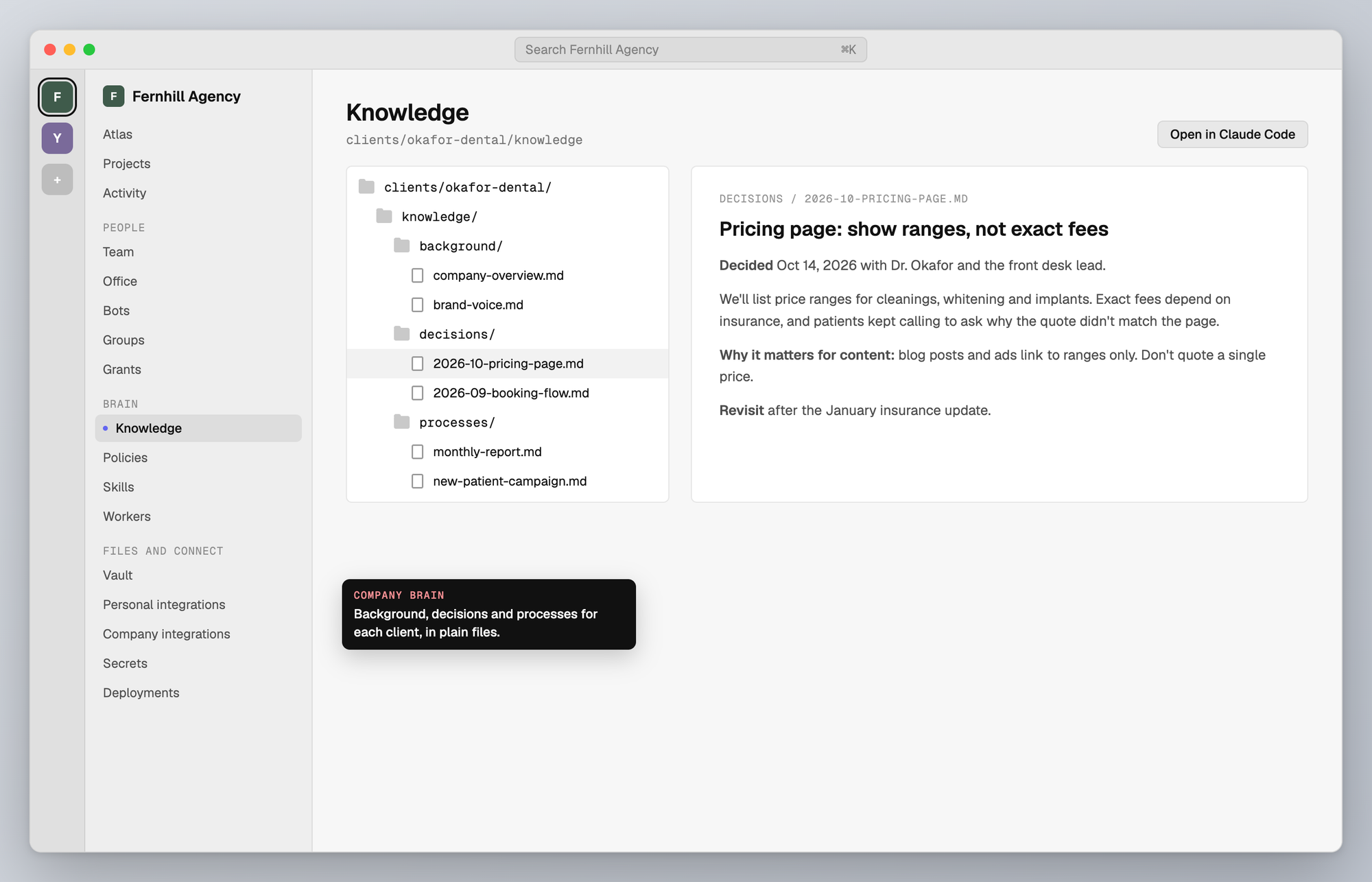
HQ is a shared home for your company's knowledge, and the files in it are your company brain. They're ordinary markdown files the whole team works from, and people use them from the HQ app and from AI tools like Claude Code, Codex, Cursor, ChatGPT and Claude chat.
For the consultancy, each client gets its own workspace with its own storage, and you set who can see or change each part per person and per group. HQ can also record client calls and turn them into notes, decisions and action items in that client's workspace,.
Processes can be saved as skills the team runs the same way, and keys go into a secrets store instead of the brain itself. See building a shared company brain for more.
FAQ
Is a company brain the same as a knowledge base?
They overlap, but a knowledge base is usually written for people to search, and a company brain is written so AI tools can read it at the start of a task, with access rules for who sees what.
Is a small team too small for a company brain?
Even a five-person team already has knowledge only one person holds, and a handful of shared files is enough to start.
Can ChatGPT or Claude memory act as a company brain?
Built-in AI memory doesn't work as a brain for a team, because Claude chat keeps memory per project [2], and Claude Code's auto memory stays on one machine [3], so neither is shared across people and tools.
Should API keys go in the company brain?
API keys belong in a secrets store that tools use when they run, so they never sit in files every AI tool reads.
Sources (4)
- Inefficient knowledge sharing costs large US businesses $47M a year, HR Dive on Panopto's Workplace Knowledge and Productivity Report (July 18, 2018), checked November 9, 2026.
- Using Claude's chat search and memory to build on previous context, Claude Help Center, checked November 9, 2026.
- How Claude remembers your project, Claude Code docs, checked November 9, 2026.
- AGENTS.md, OpenAI Codex docs, checked November 9, 2026.
Last updated November 9, 2026. Facts checked November 9, 2026.