To get every teammate's AI writing in your brand voice, DTC brands need one written voice file that everyone's AI tools read, kept in a place the whole team can reach. That file holds your tone rules, banned words, approved product claims, and real examples by channel. Turn it into a shared skill, give one person the job of updating it, and log every correction there instead of in someone's chat history.
Key takeaways
- Voice drifts because each teammate prompts their own AI from memory of the founder's tone.
- A good voice file includes approved claims and real examples, alongside the tone rules.
- Corrections go back into the shared file, so one fix reaches every teammate's next draft.
Take a 10-person coffee brand that sells on Shopify. The founder wrote the first product pages herself, and her AI drafts sound like her because she spent months correcting them.
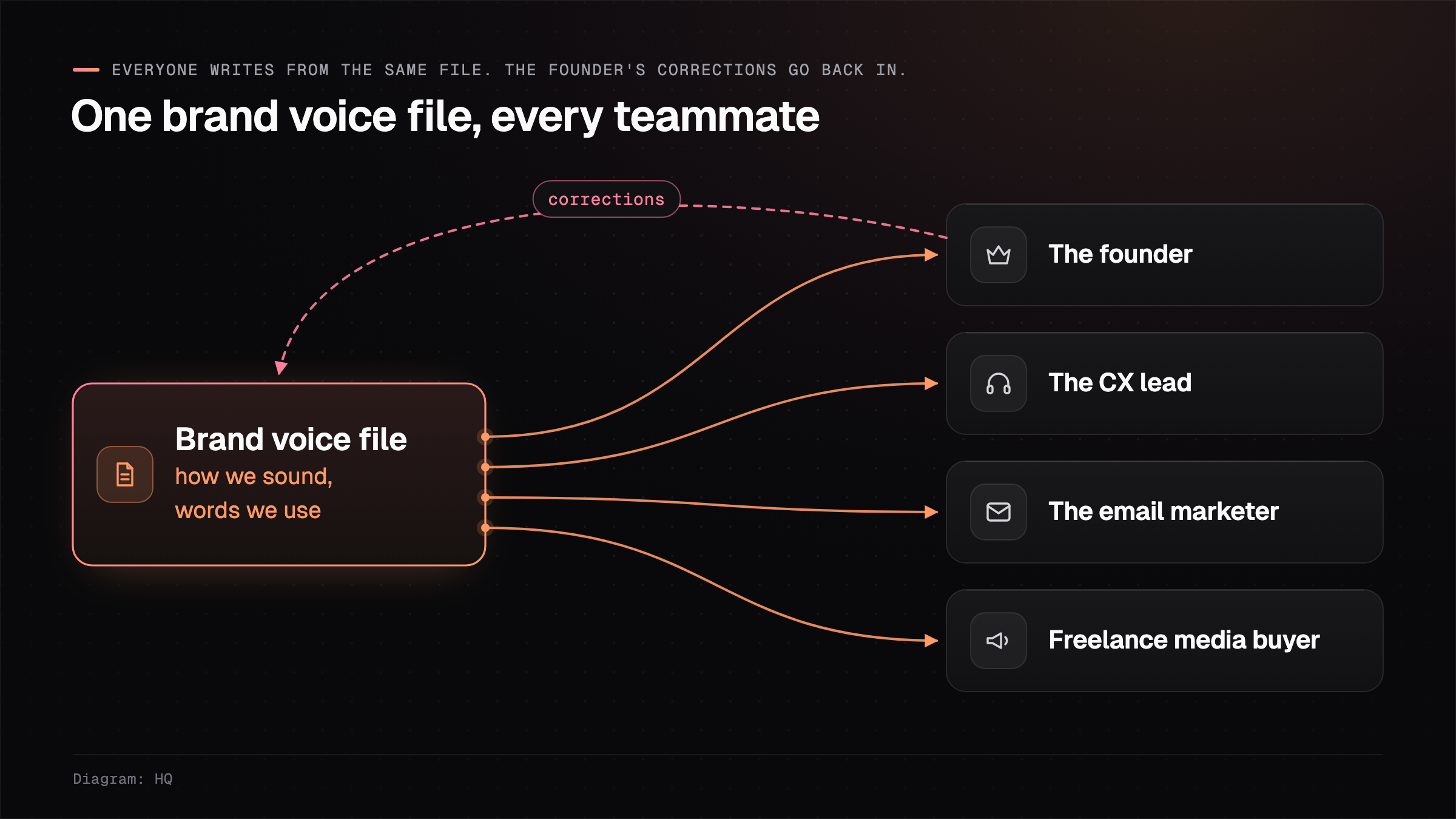
Now the CX lead answers tickets with ChatGPT, the email marketer drafts in Claude, and a freelance media buyer writes ad copy in whatever tool they like. Each of them ends up writing a slightly different version of the brand.
Why does AI writing drift off-brand when the whole team uses it?
AI writing drifts off-brand because the voice lives in one person's head and one person's chat history. Every teammate starts from a blank prompt, describes the brand from memory and fixes the output by hand, and none of those fixes reach anyone else.
Deadline pressure makes it worse. In Optimizely's 2026 survey of 2,003 marketing leaders, about one in four said they'd published AI content they knew wasn't on-brand when deadline pressure hit, and in the US it was one in three [1].
30%
Share of marketing leaders who say their brand voice is genuinely unmistakable.Source: Optimizely 2026 global study, checked November 9, 2026
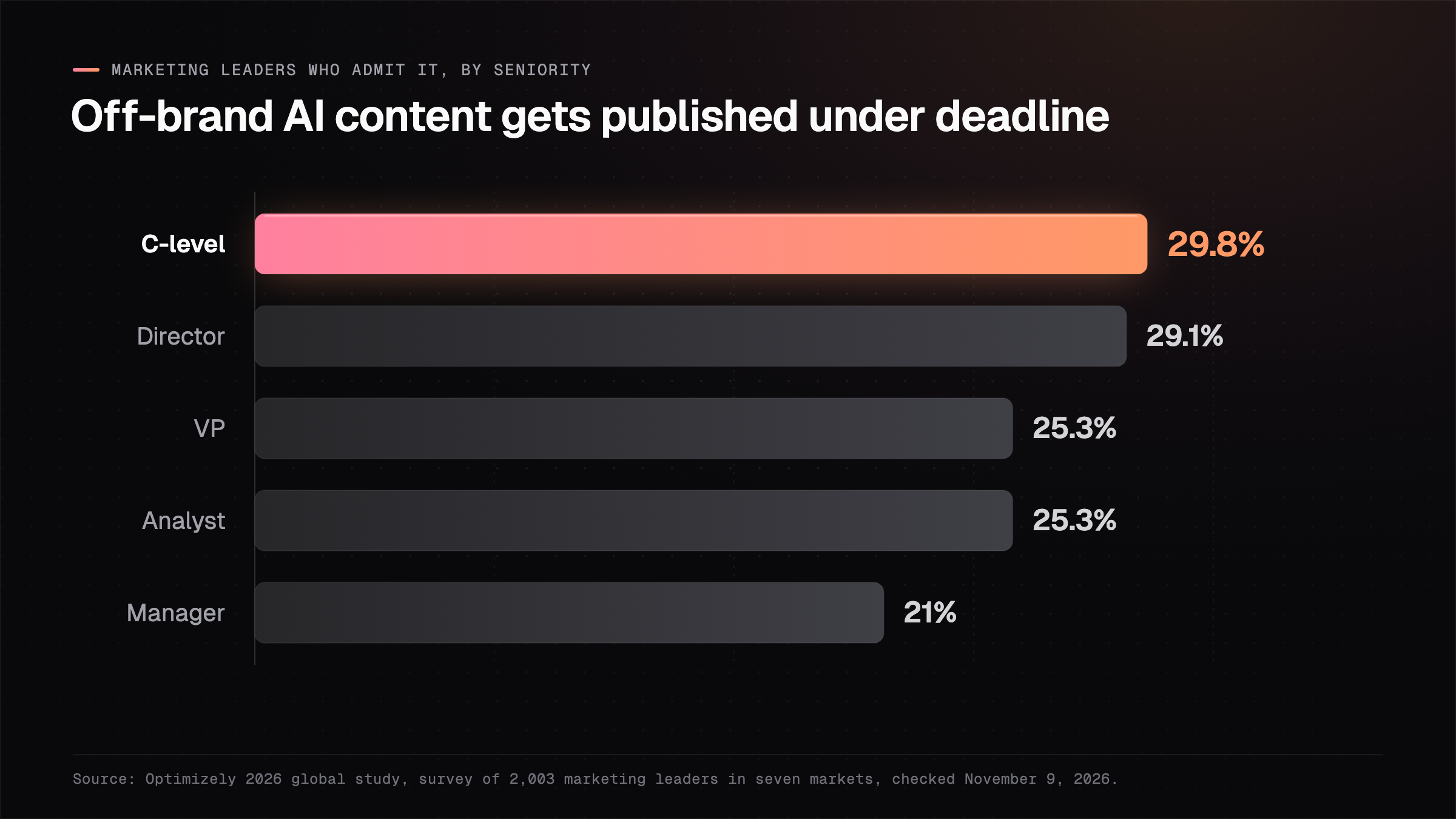
For a small brand, the fix is to write the voice down in a file any AI tool can read.
What should a brand voice file include?
A good voice file includes enough for a new hire's AI to write a passable first draft with no other help. Tone adjectives alone won't get you there, because the examples and the approved claims do most of the work.
Brand voice file checklist
Tone rules
How you sound, with a sentence that's on-brand and one that isn't.
Words you use and words you don't
"Roasted Tuesday" yes, "artisanal" no, and product names spelled the way you spell them.
Approved product claims
What you can say about sourcing, caffeine, or shipping, and what legal told you to drop.
Examples by channel
Two or three real pieces each for email, ads, product pages, and support replies.
Corrections log
Every fix the founder makes, written as a rule with the date.
Give support replies their own examples, since a refund email and a launch email shouldn't sound the same, and the CX lead is the person most likely to be writing with AI all day.
Quick check: ask two teammates to have their AI write the same back-in-stock email, then read both side by side. If you can't tell which one the founder would send, start the file with what's different.
Once the file exists, the harder part is getting it into four different people's AI tools.
How do you get the voice file into every teammate's AI?
The simplest way to reach every teammate's AI is to turn the file into a skill and share it from one place. A skill is a set of instructions an AI loads when the task calls for it, and Claude supports skills on Free, Pro, Max, Ultra, Team, and Enterprise plans [2].
On Claude Team and Claude Enterprise, a skill you share is view-only, and the people you share it with get your updates the next time they use it [2]. A Claude Team seat costs $25 a month billed monthly or $20 billed annually [3]. We covered how that sharing works in our guide to sharing Claude skills with a team.
Option 1
Paste it into each person's tool
Works with: any AI tool
Catch: every update means everyone pastes it again
Option 2
Shared Claude skill
Works with: Claude Team or Claude Enterprise seats
Catch: the ChatGPT user and the freelancer sit outside it
Option 3
One shared brand folder
Works with: each teammate's own AI tool
Best for: mixed tools and outside help
For the coffee brand, option 2 covers the email marketer and the founder. The CX lead on ChatGPT and the freelance media buyer need the file somewhere their tools can also read.
How do you keep the brand voice current?
Brands keep their voice current by giving one person ownership of the file and sending every correction there. When the founder rewrites a line, the fix becomes a rule in the corrections log, so the next draft from anyone's AI already has it.
A short monthly review helps too. Pull five recent AI drafts from different channels, read them against the file, and add whatever the file missed.
A correction that stays in one person's chat only fixes one person's drafts.
Where you keep the file decides which teammates' AI tools can read it.
How this works in HQ
HQ is a shared folder your team and their AI tools work from, and your brand voice file is one of the first things worth putting there. The coffee brand's voice file, approved claims, and example emails sit in one place next to the rest of the company's files, and the brand-voice skill lives beside them.
Each teammate connects the AI tool they already use, whether that's Claude, ChatGPT, Claude Code or Codex, and those tools read the same files. When the founder adds a correction, the CX lead's next refund reply and the media buyer's next ad draft both work from it. You choose per person and per group who can change the file and who can only read it, so the freelancer gets the voice without editing it.
For more on this, see keeping brand voice consistent in AI. You can start free with $10 of usage included every month.
FAQ
How do I train AI on my brand voice?
Teaching AI your brand voice doesn't require training a model. You write a voice file with tone rules, approved claims, and real examples by channel, then load it as a skill or file in the AI tools your team uses.
Can teammates on ChatGPT use a Claude brand voice skill?
Claude's built-in skill sharing stays inside your Claude organization [2]. Skills are plain files in the open Agent Skills format [4], so a shared folder both tools can read covers teammates on ChatGPT.
How long should a brand voice file be?
A brand voice file should be long enough to hold two or three real examples per channel and every correction you've made. For a small DTC brand, a few pages is a good target.
Should customer support replies use the same brand voice?
Support replies should use the same brand voice, though support needs its own examples. They share the brand's tone but need calmer phrasing for refunds, delays, and complaints, so give them a separate section in the file.
Sources (4)
- Optimizely 2026 global study, survey of 2,003 marketing leaders in seven markets, checked November 9, 2026.
- Use skills in Claude, Claude Help Center, checked November 9, 2026.
- Claude pricing, checked November 9, 2026.
- Agent Skills, open standard site, checked November 3, 2026.
Last updated November 9, 2026. Facts checked November 9, 2026.