An AI adoption plan for a 20 to 200 person company takes about 90 days. You pick one approved AI tool, write a one-page use policy, and put your company docs somewhere the AI can read them. Then one team runs a 30-day pilot on two or three tasks it does every week, and after that you train everyone with examples from your own work and bring the other teams in one at a time, each with its own owner.
Key takeaways
- Most of your staff already use AI on their own, so the plan sets the tool, the rules and the shared docs.
- A 30-day pilot with one team on real weekly tasks shows you what to fix before everyone joins.
- JPMorgan Chase and BNY trained thousands of staff alongside their AI rollouts.
Our example is an 80-person professional services firm where a dozen people pay for their own AI subscriptions and nobody knows which client files have gone into them. The founder wants one plan the whole company follows by the end of the quarter.
Why do AI rollouts stall at small and mid-size companies?
AI rollouts at smaller companies stall because people start using AI on their own before the company gives them an approved tool, training or shared docs to work from. The tools are already in use, and what's missing is any agreement on how to use them.
Microsoft's 2024 Work Trend Index surveyed 31,000 knowledge workers in 31 markets and found that 75% use generative AI at work. Of those AI users, 78% bring their own tools, rising to 80% at small and mid-size companies, and only 39% got AI training from their company [1].
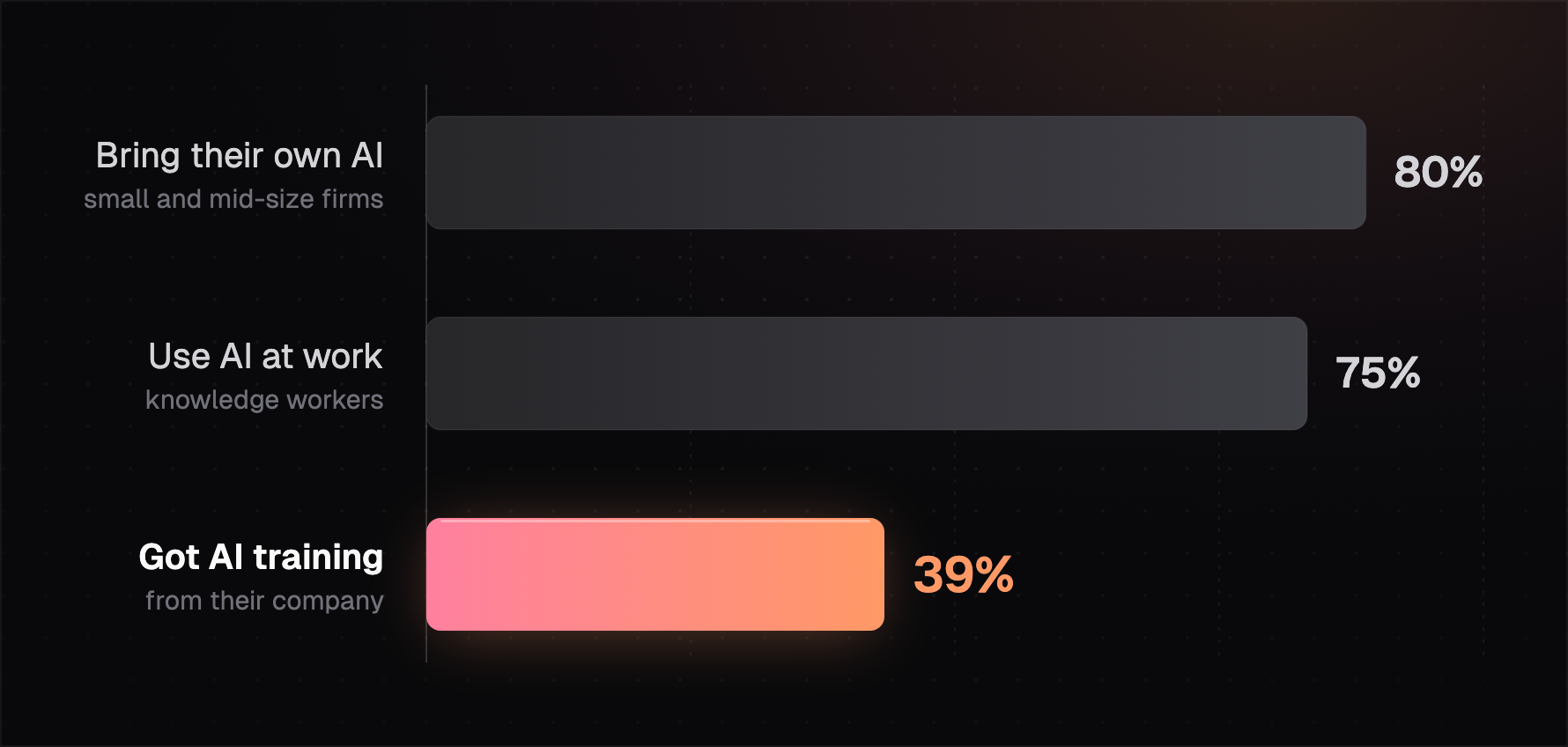
39%
Share of AI users at work who got AI training from their company.Source: Microsoft Work Trend Index 2024, checked November 16, 2026
A company with 20 to 200 people has no AI team to close that gap, so the plan has to be simple enough for one person to run alongside their normal job.
What does a 90-day AI adoption plan look like?
A 90-day AI adoption plan for a 20 to 200 person company has four phases, which are a tool and policy, shared company docs, a pilot, and a team-by-team rollout. Each phase has a finish line, so you know when it's time to start the next one.
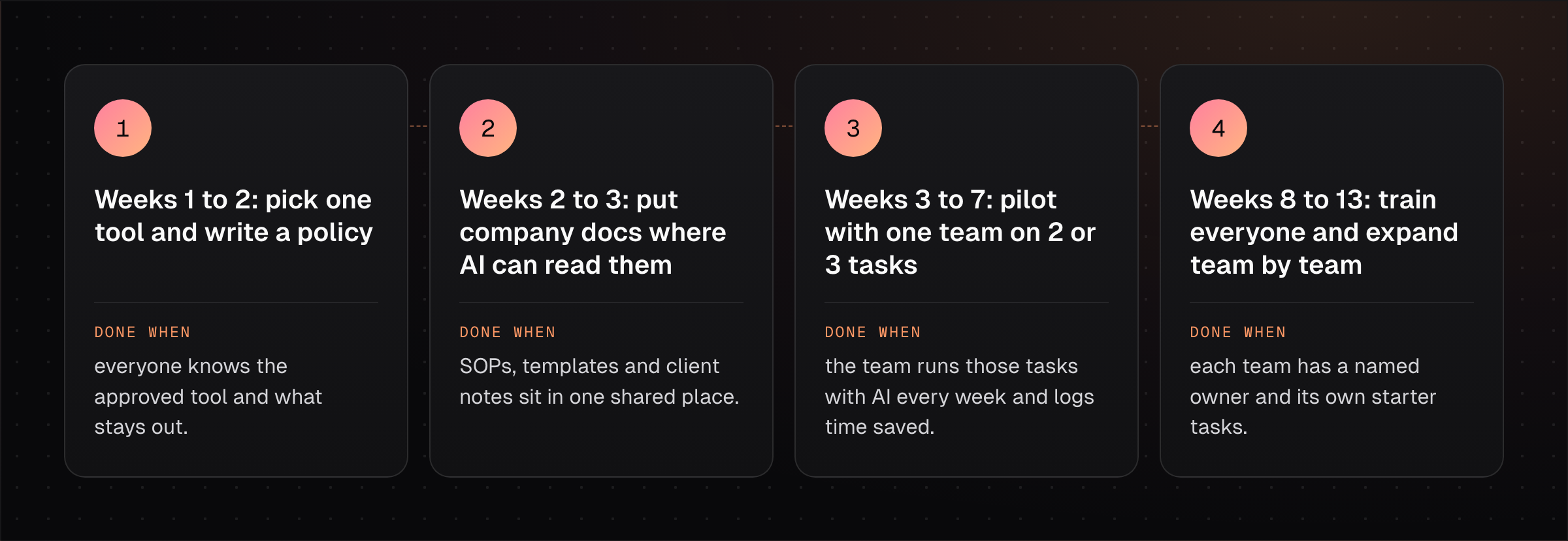
The policy fits on one page. It names the approved tool, lists what never goes into any AI tool (client contracts, salary data and passwords), and says who to ask when something's unclear.
For the pilot, pick the team that does the most repeated writing or research, such as client reporting or proposals. Our 80-person firm picked its five-person account team, which piloted the weekly client update and first drafts of proposals.
Quick check: ask five people which AI tools they used this week and what they pasted into them, and use their answers as the first draft of your policy.
The training phase in that plan comes straight from what two large banks did when they rolled out their own AI assistants.
What can a smaller company copy from big-company AI rollouts?
A smaller company can copy the training that JPMorgan Chase and BNY ran alongside their rollouts, where staff learned to write prompts for their own work and a group of them learned to build tools for everyone else. Neither step needs a big budget.
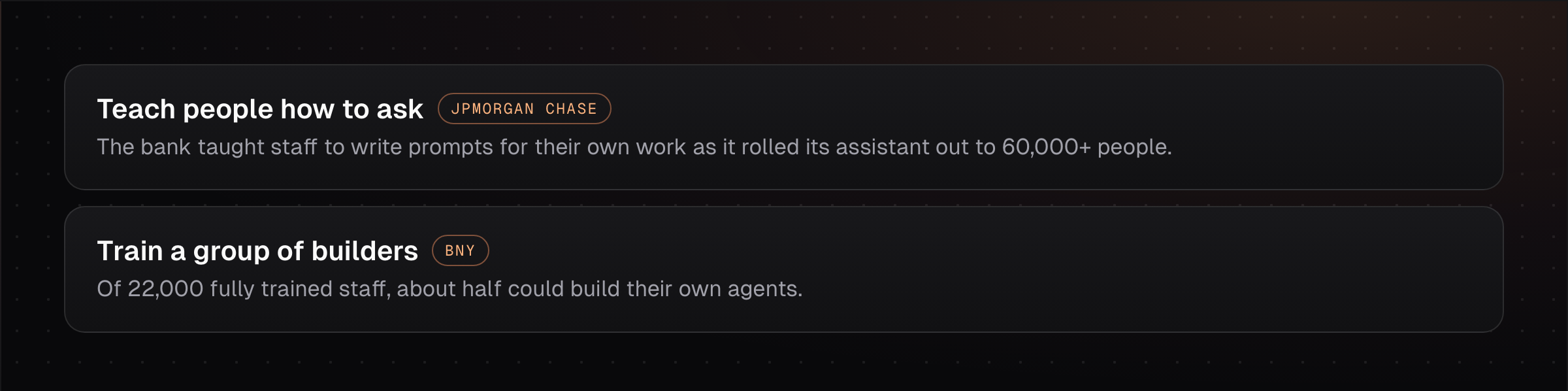
JPMorgan Chase had its in-house assistant, LLM Suite, in front of more than 60,000 employees by August 2024. Its chief data and analytics officer told CNBC that people have to be taught prompting that fits their own field [2].
BNY gave more than 50,000 employees its Eliza platform. By January 2025, 22,000 of them were fully trained, about half of those could build their own agents, and 80% of the bank's developers used GitHub Copilot every day [3].
Both banks trained their staff on their own work, and thousands of BNY employees went on to build tools for their colleagues.
At 80 people, the builder group is three or four people who turn the pilot's tasks into shared skills that the rest of the company runs. Once those skills exist, you need numbers that show whether they save time.
How do you know AI adoption is working?
AI adoption is working when the pilot tasks take less time and people stop rewriting what the AI gives them. Seat counts tell you who has access, and they don't tell you whether anyone saves time.
For each pilot task, track the time it takes before and after, how much people edit the output, and how many people run it each week. Our account team timed the weekly client update for two weeks before the pilot, so the 30-day result had a baseline to compare against.
When people keep editing heavily, the AI is missing something it needs to read, such as the client's history or your house style. Add that to the shared docs before the next team joins, because every later team works from the same docs.
How this works in HQ
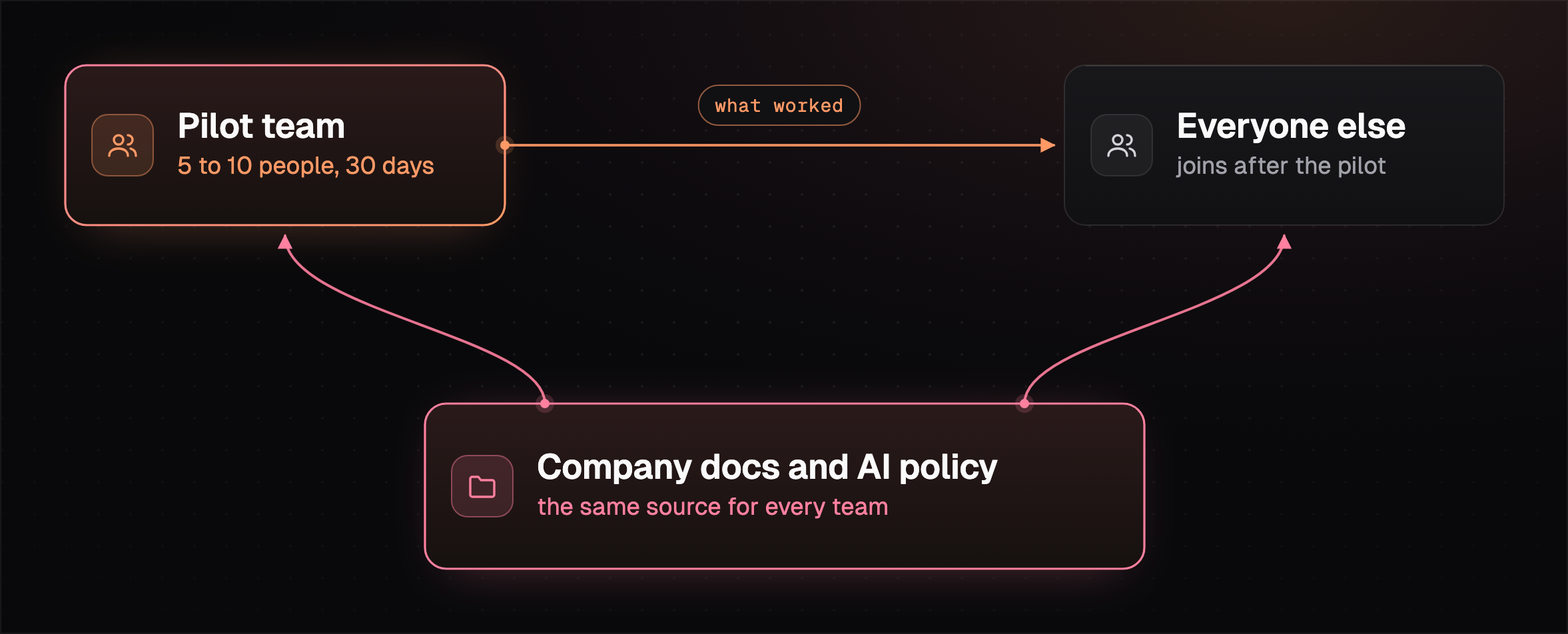
HQ is a shared home for your business context, so every team that adopts AI starts from the same files.
- Your AI policy, style guide and client notes live in one place.
- People keep using Claude, ChatGPT, Claude Code or Codex.
- When the pilot team saves a skill, the whole company can run it.
Read about company-wide AI adoption, or see how to roll out Claude skills to sales and CS. You can start free with $10 of usage a month.
FAQ
How long does AI adoption take at a 50-person company?
AI adoption at a 50-person company takes about a quarter, with two to three weeks for the tool, policy and shared docs, a 30-day pilot, and about a month to bring the other teams in.
Who should own AI adoption at a small company?
One named person should own AI adoption at a small company, such as the COO or an operations lead, and each team gets its own owner once the rollout expands. The owner doesn't need a technical background, just time each week to collect what's working.
Should we ban personal AI tools during the rollout?
Naming an approved tool and listing what can't go into any AI tool works better than a ban, since Microsoft found 78% of AI users already bring their own tools to work [1].
What should an AI training session cover?
A first AI training session should use real tasks from your own company, show a good prompt next to a weak one, and end with a shared list of prompts that worked. That matches the field-specific prompting JPMorgan Chase described [2].
Sources (3)
- AI at work is here. Now comes the hard part (2024 Work Trend Index), Microsoft and LinkedIn, May 8, 2024, checked November 16, 2026.
- JPMorgan Chase gives its employees an AI assistant, CNBC, August 9, 2024, checked November 16, 2026.
- BNY details use cases and cultural transformation, Cloud Wars, January 31, 2025, checked November 16, 2026.
Last updated November 16, 2026. Facts checked November 16, 2026.